Catharsis through Food

Updated: Oct 25, 2025
"This play is not just my personal story; it is a collage of many people around me who have been hungry but were reticent to express it." Meghna Roy Choudhury speaks about her solo piece, Kheyechish?
What does Kheyechish? mean and how do you pronounce it?
‘Kheyechish?’ in Bangla roughly translates to 'Khaya kya?' in Hindi, or 'Khalle?' in Marathi. 'Have you eaten?'
The pronunciation can be tricky, even for our team. Khe of ‘khelna’, Ye as in when you call out to someone “Ae!”, Chi like when you say “Chi!” in disgust, and Sh as in “shhh.” Put it together and you get Kheyechish.
What was the genesis of the play?
2023 marked Bertolt Brecht’s 125th birth anniversary, and Bhasha Centre had organised a playwriting platform called Brecht@2023.
I must admit, I never enjoyed Brecht’s work when we were forced to read it in drama school. I hope people don't get offended by this, but seeing the conflicting ideologies of Bengali communists has always given me a very confused perception of communism. I mean, we all have that one communist family member who still believes in caste and can be a bit of a bigot.
So for this reason, and more... Brecht’s work felt very distant to me.
But that year, everyone was talking about him, and I was curious.
2023 was also the year I moved to Mumbai with almost no money. I had a job as a theatre facilitator that paid me Rs. 18,000 a month for working six days a week, eight hours a day, with no travel allowance, and I had to constantly commute between North and South Mumbai, sometimes three times a day. My rent was Rs. 11,500, and my coffee taste was unfortunately bourgeois. I used to attend rehearsals for a play that stood far from my political beliefs, but I went because the dinner there was free.
One night, the rehearsal got cancelled (which meant no dinner), and to distract myself I thought, chalo, let us explore Brecht. I stumbled upon a treasure of his writings on food, a side of Brecht that suddenly felt honest to me.
Then I read his poem The Shopper. There is a line that broke me:
If all of us who have nothing
No longer turn up where food is laid out
They may think we do not need anything
But if we come and are unable to buy
They will know how it is.
I was sobbing. And that was the seed of Kheyechish?
That, and my maa asking me every day, “Kheyechish?” and me lying to her.
But your hunger was by choice, not by actual lack or inability to provide for yourself...
Yes, absolutely. I am fully aware of the privilege of choice, especially when it comes to migration and hunger. My great-grandparents and grandparents were refugees, and I have seen them build a better life for me until their last breath, without complaining about their forced migration or the hunger they endured during the Bengal famines, although sometimes their eyes would moisten.
So I absolutely know, and in this play I also question whether my hunger, and my colleagues’ hunger, is even valid. This play is not just my personal story; it is a collage of many people around me who have been hungry but were reticent to express it.
The entire process for me has been a revelation. My team and I would exchange stories of food; it created a wholesome, shared experience.
Dhanesh Gopalakrishnan, a talented actor and voice over artist, Sagar Dahale, the sound designer and operator who can work with all his limbs at once, and our light operator Utkarshh Babbar, a fascinating theatre maker with a unique sense of humour, shared their own experiences of hunger, migration, and even food recipes; four of us come from four different corners of the country.
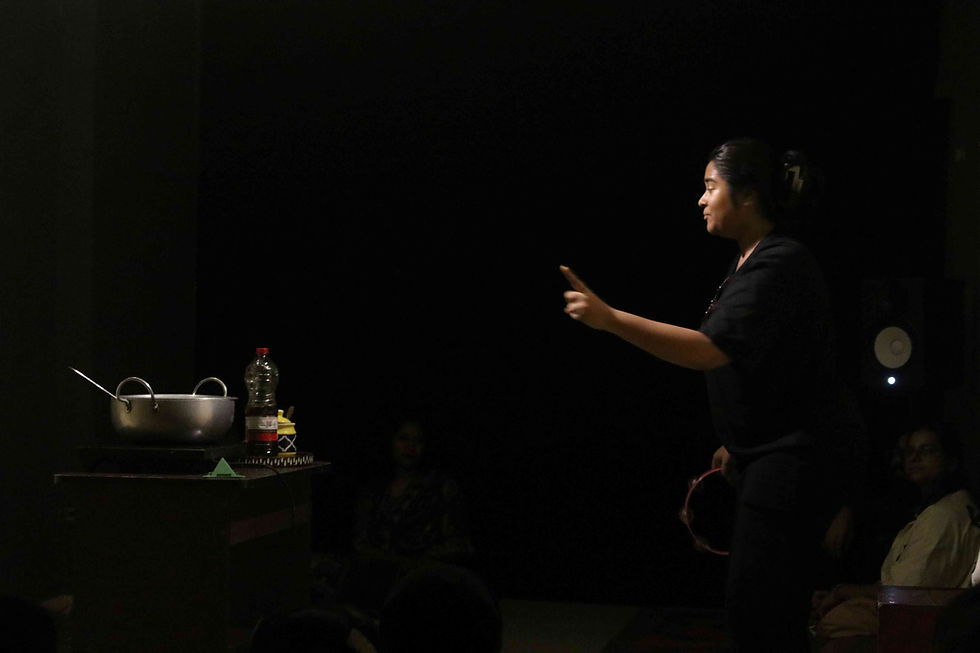
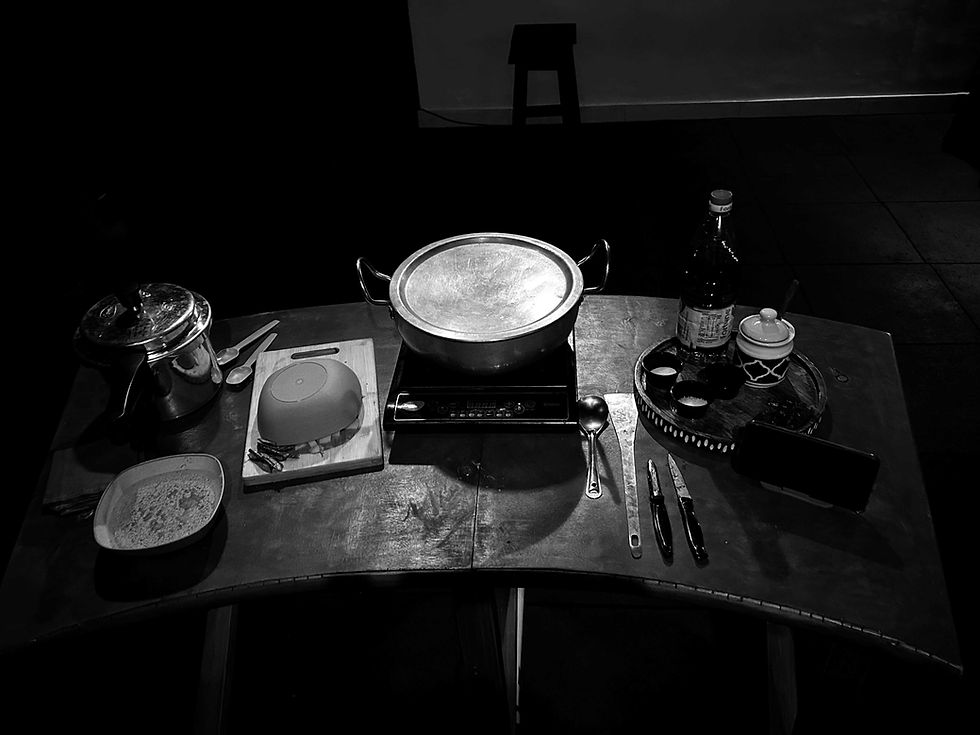
Even the audience participated in this catharsis through food. On stage, I cook alu posto and phena bhaat, ironically two famine-born dishes... And after the show people stay back to eat and invariably share their own memories of being hungry, their own food stories.
It turns out that while food is a great conversation starter, so is hunger. We find commonalities, we are able to relate to someone whose lived experience is far removed from ours.
Three things that you have learnt in the process?
Only three??? Okay here goes.
1) I have always wanted to explore the tools of stand-up comedy in a theatre format, and it was challenging, but I think I have grown technically as a performer. I have learned the importance of timing and how it can change from venue to venue and show to show.
2) I was procrastinating, avoiding cooking on stage. That took away a lot of my time during the 40-day process. It was only in the last ten days that I finally gave in, tried cooking, and it worked beautifully for all of us and the story. So I guess I learned not be afraid to experiment, to instead try every idea early on.
3) Finally, a good team is everything. Theatre thrives on strong collaborations and that includes the venues and the audience, and having the right people around makes all the difference.
What have some audience responses been? Are you nervous about showing this to Bengalis?
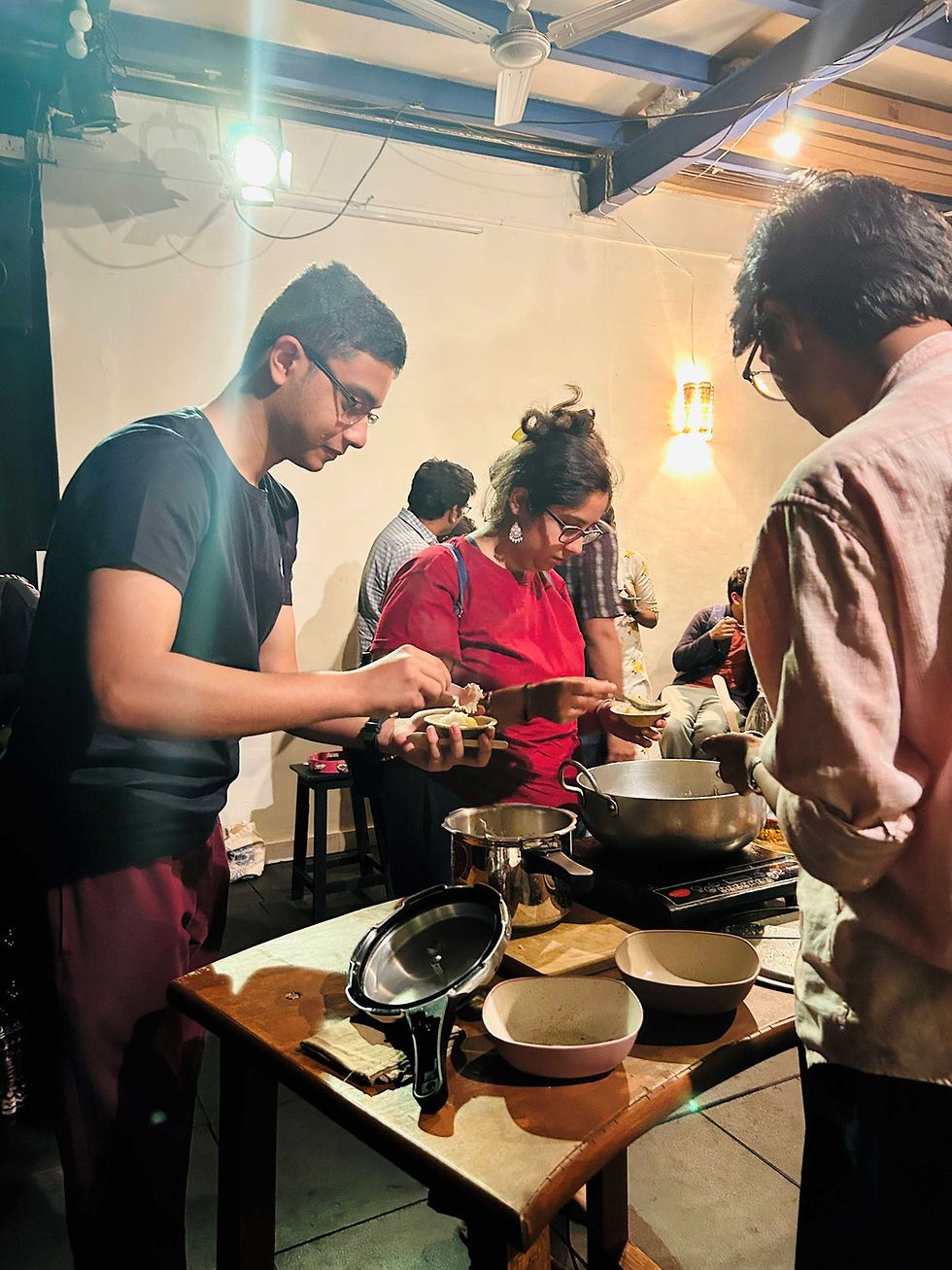
The audience response so far has been deeply cathartic, especially for people who are new to living away from home.
Mothers come up to me with teary eyes, saying how worried they are about their children living far away, and youngsters telling me they wish to show this piece to their parents, hoping it could bridge the communication gap that formed after they moved out.
What I love most is the sense of celebration after the show ends, when people serve themselves food, talk to each other, and the venue fills with chatter. And as for the Bengalis, they absolutely love it. So no, I am not nervous. In fact, I have made many new Bengali friends in the city because of this play.
After this minimalist one-person performance, you attempted Kadambari, an intricate ensemble piece. What was the journey like from here to there?
With Kadambari I felt relieved that I did not have to direct myself. Working with an ensemble brings such varied energies, and as a director it is a joy to play with that. But Kheyechish? demands a lot, it requires honesty, bravery, and the process has often been lonely. Thankfully, I have my co-actor Dhanesh’s brilliant voice to play off, and since there is no physical body present on stage, his voice helps me immensely. The food, utensils, and the table have also become my ensemble, objects that I draw energy from while performing.
How many shows have you completed? Do you have a favourite venue?
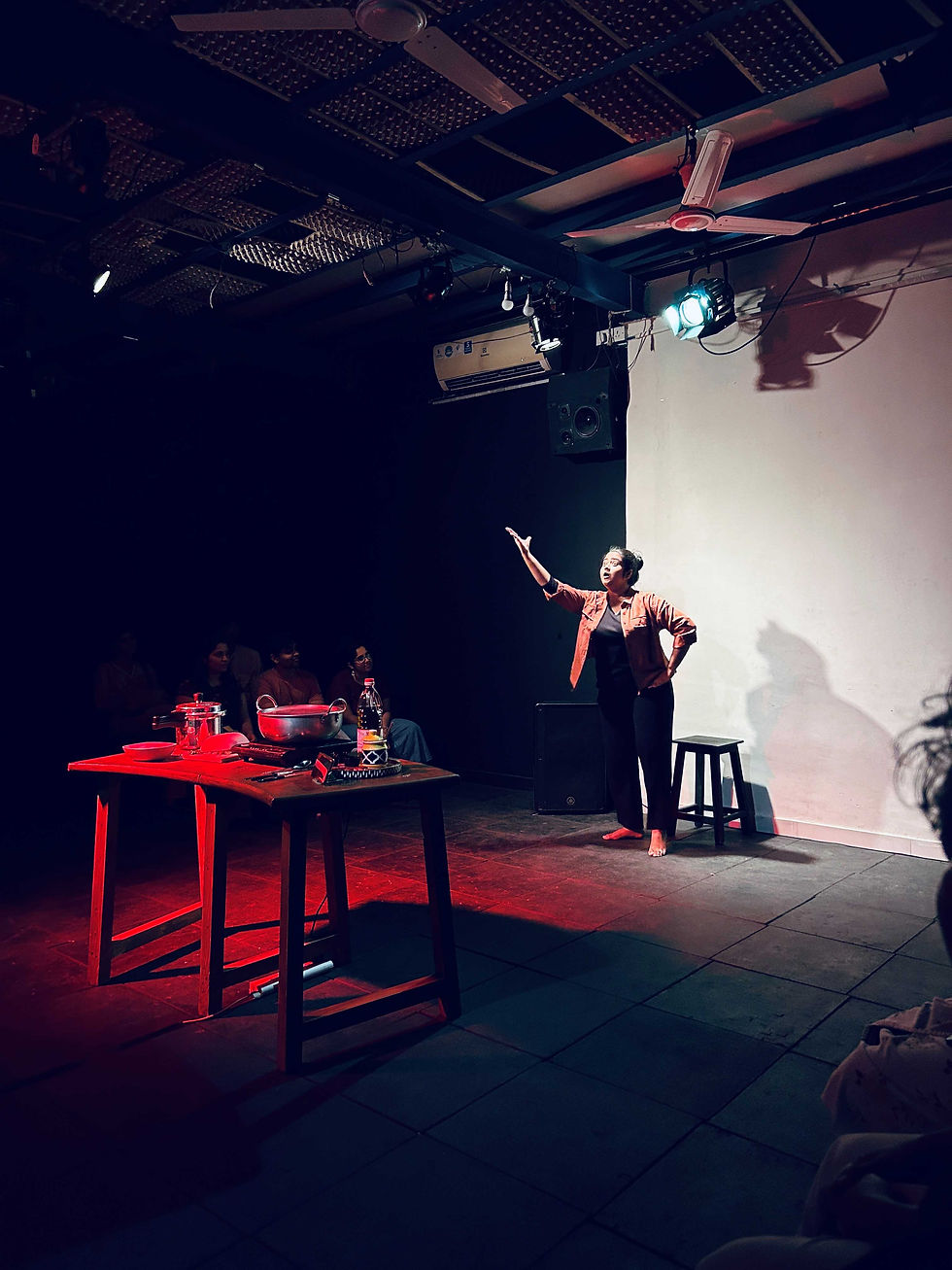
We have completed six shows since the premiere in February this year. Each venue has been special in its own way, and the venue really matters for this play because every space brings its own audience and energy.
Nirmik Cultural Centre was wonderful, we performed for audiences from different demographics, which made me confident that the play resonates across ages, professions, languages, and economic backgrounds.
But Harkat Studios will always feel like home to me, it is intimate, warm, and holds a special place for all my plays.
--
About the piece: Kheyechish? sits at the intersection of theatre, storytelling, oral history, and shared ritual. It explores not only hunger for food, but also for dignity, recognition, and community. 'Kheyechish?' is inspired by Brecht's poem The Shopper and was developed with the Niloufer Sagar Alumni Production Grant run by Drama School Mumbai.
The Team
Written and Directed by: Meghna Roy Choudhury
Dramaturgy by: Siddhesh Purkar
Performed by: Meghna Roy Choudhury & Dhanesh Gopalakrishnan
Light designed by: Rahul Rai
Light operated by: Utkarshh Babbar
Sound designed and operated by: Sagar Dahale
Set designed by: Ravi Choudhary
Mentored by: Akhshay Gandhi
Main Poster designed by: Aakriti Chandervanshi


Comments